
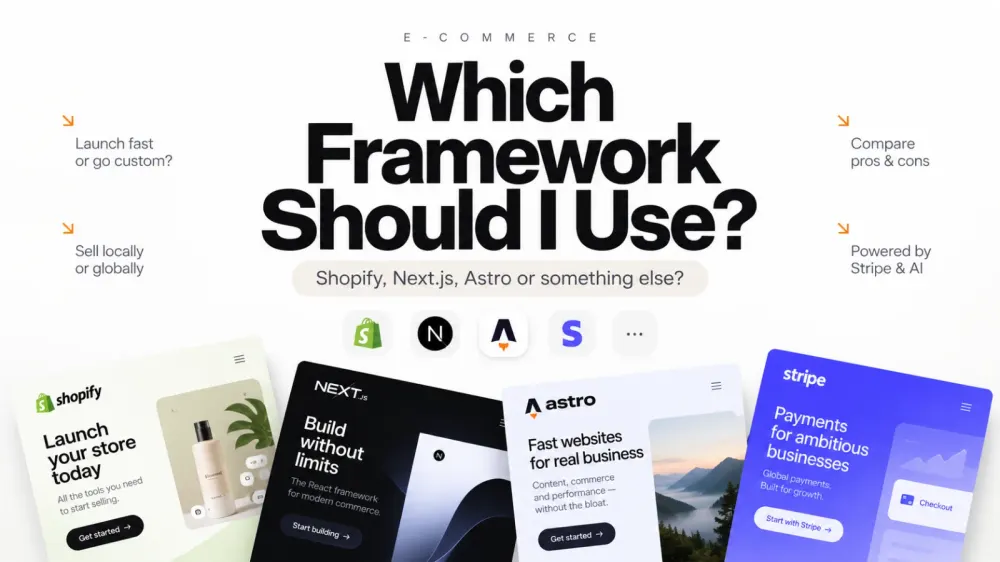
Shopify Is Still Great
If you want to launch quickly with minimal development, Shopify is hard to beat.
You get products, inventory, checkout, payments, orders, customers, shipping, analytics, and a huge app ecosystem out of the box.
But as your store grows, you may also grow dependent on:
Paid apps
Plugins and integrations
Theme limitations
Monthly platform costs
Conflicting apps
Shopify-specific functionality
For a standard store, that's often completely fine.
But what if you want something more custom?
This Is Where Next.js + Astro + Stripe Gets Interesting
Today, you can build an e-commerce website using a modern framework such as Next.js or Astro, connect it to a CMS, and use Stripe for payments.
For example:
Next.js / Astro → Website & user experience
CMS → Products & content
Stripe → Payments
Database → Customers, orders & business data
Vercel / Netlify → Hosting
Instead of everything living inside one platform, you have a composable system where each part does what it does best.
Next.js
Great when your store needs more application-level functionality, custom interactions, dashboards, APIs, personalization, or complex business logic.
Astro
Excellent when your website is heavily content-driven and you care about performance, SEO, and delivering minimal JavaScript.
Both can work very well for e-commerce.
But Isn't Custom Development Expensive?
It used to be much harder.
AI has changed the development process.
AI can now help developers build components, APIs, database structures, Stripe integrations, CMS connections, authentication, and other repetitive parts much faster.
That doesn't mean AI replaces developers.
It means the cost and time required to build a custom solution can be significantly lower than before.
So businesses can now consider architectures that previously may have been too expensive or complicated.
Local or Global — Both Work
This approach isn't only for global brands.
You could build a store specifically for:
Dhaka → Bangladesh → Global
Start with one targeted market, then expand into more locations, currencies, products, content, and integrations as the business grows.
The architecture doesn't necessarily need to change just because the market does.
So Which Should You Choose?
Choose Shopify if:
You want something fast, proven, and easy to manage, and your requirements are relatively standard.
Choose Next.js + Stripe if:
You want a highly customized store that may eventually become a larger web application.
Choose Astro + Stripe if:
Your store is heavily content/SEO focused and performance is a major priority.
My Take
I wouldn't say Shopify is bad or that everyone should move to Next.js or Astro.
The better question is:
Do I need a platform, or do I need a system I can control?
For a simple store, Shopify can be the smartest choice.
For a business that wants complete control over its website, content, SEO, integrations, and future functionality, a Next.js/Astro + CMS + Stripe architecture can be much more efficient in the long run.
And with AI-assisted development making custom builds more accessible, the gap between “use Shopify” and “build everything from scratch” is getting smaller.
That's what makes modern e-commerce architecture so interesting.