
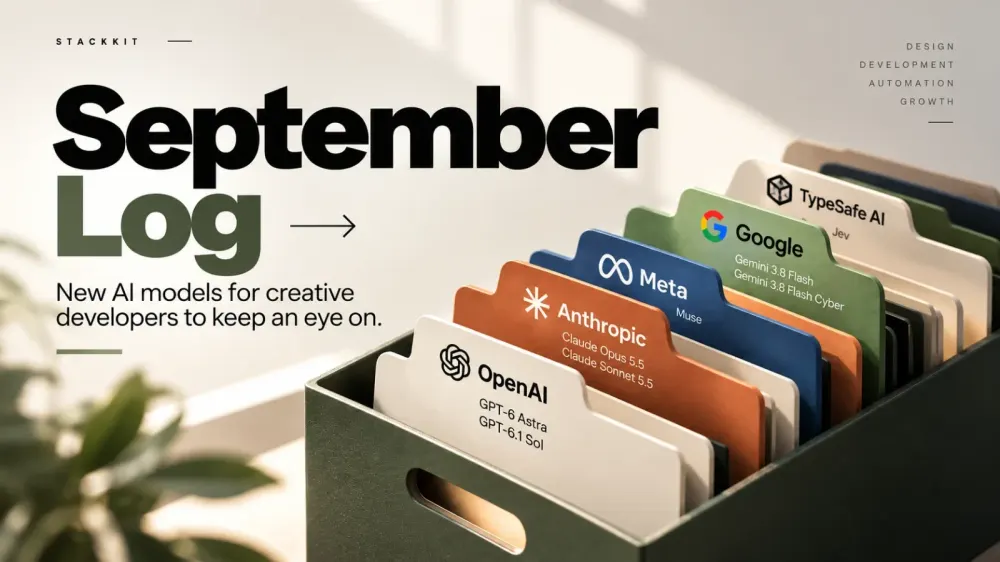
OpenAI
GPT-6 Astra
For: Frontier reasoning & complex agents
Built for demanding reasoning, complex multi-step execution and sophisticated agentic workflows.
GPT-6.1 Sol
For: Production, coding & business workflows
Best suited for high-frequency, cost-efficient production workloads, complex agentic coding and multi-step professional workflows — delivering near-frontier performance at roughly a fifth of the price of top-tier models like GPT-6 Astra.
---
Anthropic
Claude Opus 5.5
For: Complex development
Focused on difficult software engineering and long-horizon tasks. Useful for architecture, large codebases, deep debugging and complex product builds.
Claude Sonnet 5.5
For: Everyday development
A practical model for UI implementation, debugging, code review, rapid iteration and creative development workflows where speed matters.
---
Meta
Muse
For: Agentic workflows
Meta's move toward agents that operate in their own environment makes Muse interesting for developers building AI-powered workflows rather than simple prompt-and-response tools.
---
Gemini 3.8 Flash
For: Fast coding & agents
Focused on speed, efficiency and long-horizon agentic work — useful for rapid development and high-volume AI workflows.
Gemini 3.8 Flash Cyber
For: Security & development
A specialized direction for vulnerability discovery, security analysis and automated code patching, bringing AI further into the software security workflow.
---
TypeSafe AI
Jev
For: Decision-making & AI automation
A different kind of AI model focused on fast, structured decision-making rather than generating text. Interesting for routing, classification, prioritization, agent tool selection and automated workflows.
---
The September Signal
For creative developers, the interesting question isn't simply:
“Which model is smartest?”
It's:
“Which model fits the job?”
Build → Coding & agentic development
Design → UI understanding & iteration
Automate → Multi-step workflows
Grow → Research, content & analysis
Scale → Cost-efficient production
Secure → Vulnerability detection & patching
Decide → Structured AI decision-making